Do they remove your ribs? The difference between removal and remodeling →
The anatomical basis: which ribs are remodeled
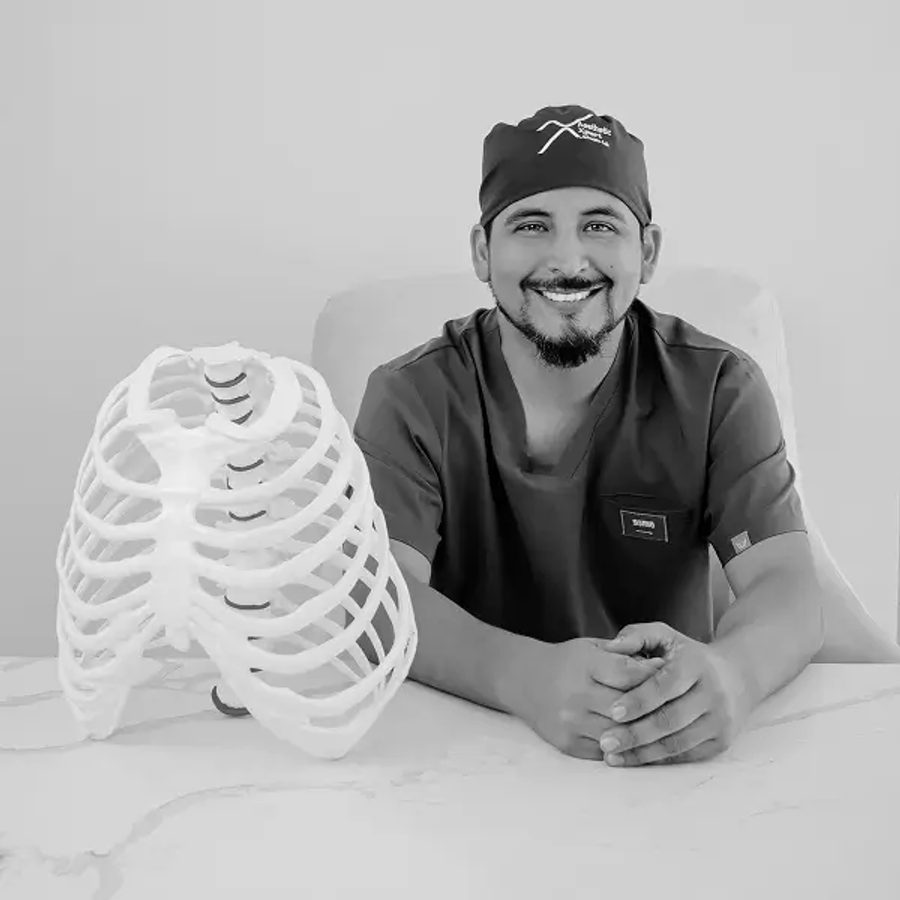
The rib cage has twelve pairs of ribs. The upper seven (true ribs) attach directly to the sternum and are not touched. The ones that define the waist contour are the lower ones: the false ribs (8th to 10th), attached to the sternum by shared cartilage, and the floating ribs (11th and 12th), which do not reach the sternum. Rib remodeling acts precisely on these lower ribs to reduce the diameter of the costal arch and, with it, the waist circumference.
How it works, step by step
Unlike techniques that remove bone, rib remodeling repositions the lower ribs instead of removing them. The published method follows a controlled sequence:
- Ultrasound evaluation. Each rib and its working point are located in real time, without radiation.
- Controlled monocortical fracture. A fracture of a single cortex of the bone —not a complete one— is produced, preserving the structural integrity of the rib while allowing it to be repositioned.
- Curving of the costal arch. The rib is brought to a new position that narrows the waist, with tactile "clack" control and image verification.
- Closure without incisions. As no open approach is required, there are no external scars and the procedure is outpatient in profile.
The "clack" and ultrasound control is part of the published method (DOI).
Ultrasound-guided, without incisions or scars
Ultrasound is what makes it possible to work the bone without opening the skin: the surgeon sees the rib and controls the maneuver at all times. That is why the technique leaves no visible external scars and avoids the open surgical approach that other waist-contouring surgeries require.
What it is NOT: no ribs are removed
Rib remodeling is not a rib removal (rib resection): it does not remove bone structure nor require an open approach. This difference is the key to its risk and recovery profile.
The instrument: "Manzaneda's Tool"
The technique is performed with a piezotome adapted by the doctor himself —"Manzaneda's Tool"—, published in PRS Global Open (2024). The instrument was developed and manufactured by Dr. Manzaneda's team and is distributed by Marina Medical. Having a specific instrument is part of what makes the procedure reproducible and standardizable.
Results and permanence
By repositioning the ribs into a new shape, the result on the waist contour is structural. Mid-term results are documented in published follow-up cohorts, including a prospective cohort of 328 patients with one-year follow-up. The individual result and its evolution are assessed by the treating surgeon in each case.
Safety and evidence
Rib remodeling is supported by more than ten peer-reviewed publications in PRS Global Open and Aesthetic Surgery Journal, and even by an multicenter systematic review. In a survey of 113 surgeons using the technique, 2.65% of respondents reported having had a serious complication. Like any surgery it carries risks and must be performed by a surgeon specifically trained in the technique. More on safety → · See all the evidence →
More about rib remodeling
Safety of the technique → · Scientific evidence →
This page is informational and cites published, verifiable evidence. It does not replace medical consultation: each case must be assessed by a qualified plastic surgeon.